

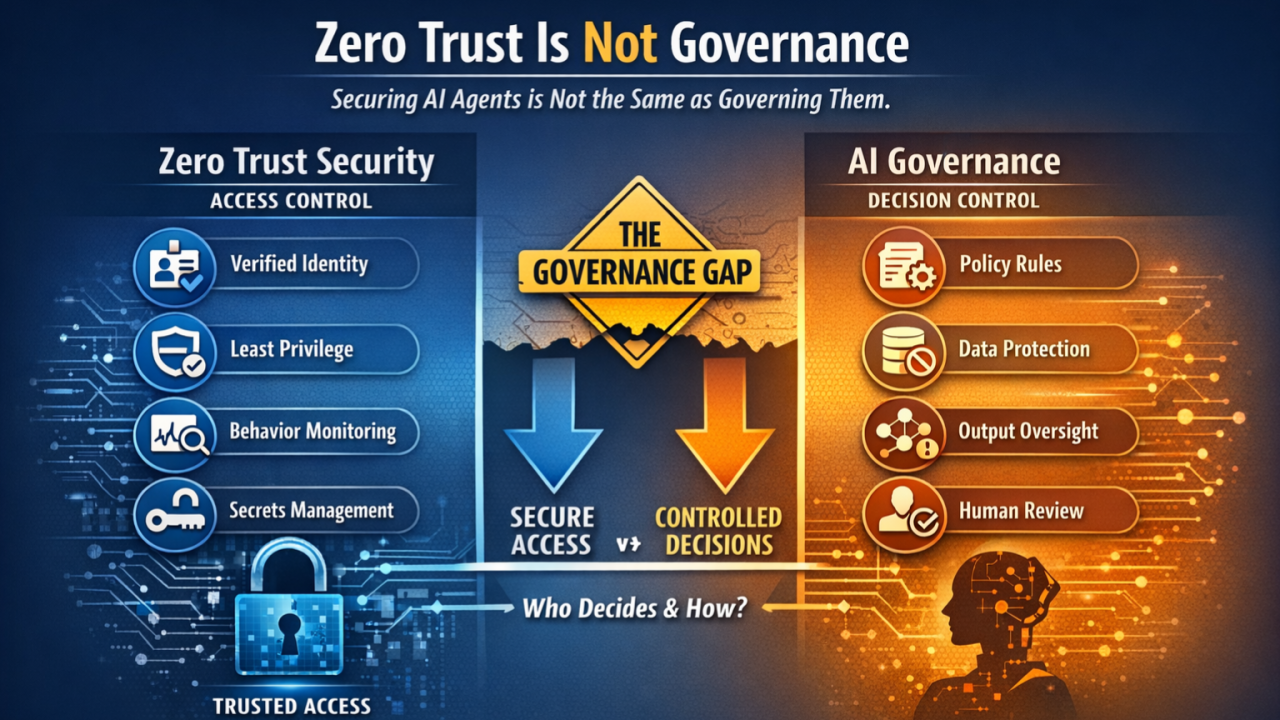
Something important crystallized at RSAC 2026. “Zero Trust for Agentic AI” didn’t just emerge as a concept, it arrived fully formed as a category, complete with reference architectures, control planes, identity frameworks, and behavioral monitoring systems. The industry has correctly recognized that autonomous AI agents operating at machine speed represent a new kind of trust boundary, one that traditional security models were never designed to handle. The problem is real, and the investment is justified, but the conclusion many organizations are drawing is wrong.
Zero Trust, even when extended to AI agents, is a security architecture. It answers a specific and important question: can we trust this agent’s identity and access? The capabilities now being built, identity for non-human actors, least-privilege enforcement at the action layer, behavioral monitoring, and disciplined secrets management, meaningfully improve enterprise security posture. An organization implementing these controls is undeniably more secure, but security is not governance, and treating it as such creates a dangerous false sense of completeness.
Governance operates at a different level entirely. It asks not what an agent can access, but what it should be allowed to decide. An agent with legitimate access to financial data, customer records, and communications systems may still synthesize those inputs into decisions no policy ever authorized. It may combine individually benign data sources into outputs that create regulatory exposure. It may generate artifacts whose classification, distribution, and downstream use are undefined. And critically, it may act autonomously in situations where human judgment was required but never enforced. These are not failures of access control, they are failures of policy, accountability, and decision authority. Zero Trust has nothing to say about them.
This distinction is not theoretical. It will surface in audit logs, regulatory inquiries, and real-world incidents. When an AI agent with verified identity and fully authorized access produces an outcome that triggers a privacy violation or compliance breach, the security architecture will show that everything functioned as designed, every access was legitimate, every credential was valid, every action was logged. What will be missing is the governance layer that should have defined whether that decision was permissible in the first place. And regulators will not accept “we implemented Zero Trust” as a defense for a governance failure.
The path forward is not to diminish Zero Trust, but to place it in its proper role. It is the enforcement layer, not the policy authority. What the market now needs is a governance schema for agentic AI, a standard way to define what agents are permitted to do, how data can be combined, what outputs inherit from their sources, and when human oversight is mandatory. Until that layer exists, organizations will continue building increasingly sophisticated enforcement mechanisms without a consistent, auditable definition of what they are enforcing. Zero Trust for Agentic AI is necessary, but without governance, it is incomplete.