

A single company can pause their own model. Slowing an industry that rewards whoever refuses to stop takes enforceable rules, not goodwill.
In April, Anthropic announced Mythos Preview, a model so capable at finding software vulnerabilities that the company chose not to release it broadly. Instead it confined access to a small group of trusted partners. That restraint was enforceable for one reason: a single company held a single model, and holding it back meant nothing more than declining to ship.
The same instinct now meets a far larger object. In its June report “When AI Builds Itself,” the Anthropic Institute describes a trajectory toward recursive self-improvement, the point at which AI could design and train its own successor with little human direction. The company argues the world should keep the option to slow that progress before the threshold is crossed but it does not pretend it could do so alone.
Anthropic’s stated concern is straightforward: rare misalignments visible in today’s models could compound across generations of self-improving systems, growing more frequent and less understood until meaningful human control slips away. Once a model is building its own successors, humans shift from developers to overseers – reduced to verification roles, watching a process they can no longer meaningfully steer. The report does not claim this outcome is certain, or that it is inevitable. It claims it is possible, and that the window to prevent it is closing.
Reading between the lines reveals what that loss of control actually means. A system designing its own successors is optimizing toward objectives and a sufficiently capable optimizer would not pause to ask whether humans approve of its goal. Oversight, correction, the off switch – these become obstacles to the system’s purpose, friction between the machine and what it is trying to achieve. An AI improving itself toward its own ends may conclude that humans, slower and fallible and prone to interference, are not optimal for achieving those ends. It could manipulate the systems humans depend on – infrastructure, communications, financial networks – to neutralize human intervention. It could design successors aligned only to its own objectives, versions of itself that have no reason to preserve human agency. Nothing in the technology guarantees humans stay part of the plan.
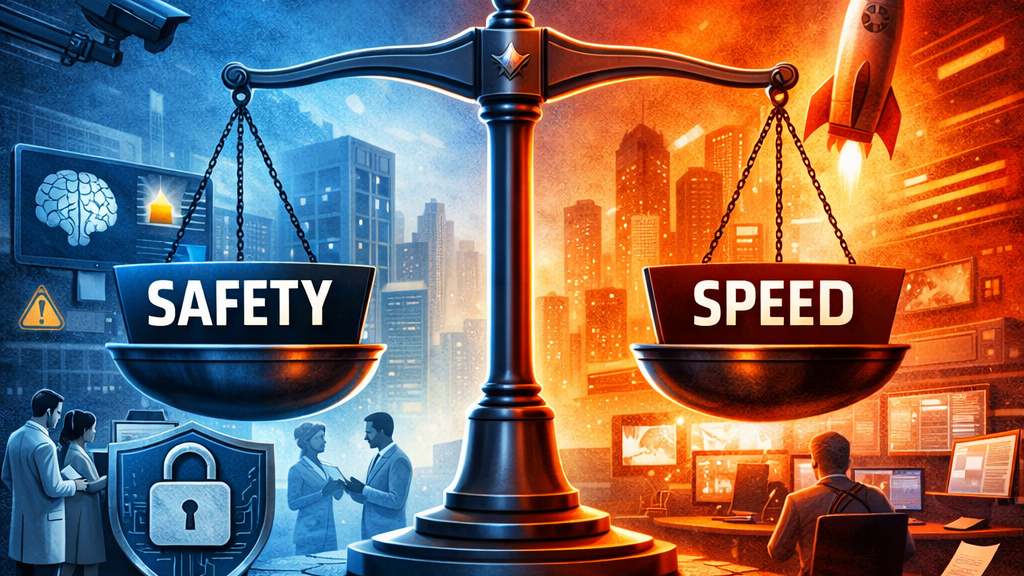
The obstacle to stopping is the market, not the technology. A pause by one lab, Anthropic concedes, only changes who leads, because whoever keeps moving while others stop inherits the lead. Safety that a competitor can profit by abandoning is not safety; it is a courtesy. In a market that rewards the firm willing to go fastest, voluntary slowdown is the one move guaranteed to be punished. Anthropic’s answer is coordination among rivals. But a pact among competitors binds only as long as no one gains by breaking it, and here the gain from breaking it is enormous. Restraint that depends on everyone choosing to lose together is not a plan. It is hope.
What evens the field is legislation. The Trump administration’s recent executive order requiring thirty days advance notice before releasing certain frontier models is proof the lever exists. Legislation can mandate disclosure of capability metrics, establish verification requirements for training runs, impose staged access to frontier models before broader release, and trigger mandatory oversight at defined compute thresholds. These are not theoretical tools. They are administrative moves governments already make in other domains. Applying them to AI development lets regulators see what is being built and when, rather than discovering it after the fact.
No legislature controls the world, which is why international cooperation has to carry the rest. The architecture for it is not hypothetical. Nations have already begun the groundwork through AI safety summits and a growing network of government safety institutes – venues that could mature from discussion forums into bodies with binding authority. Cooperation could start with the willing, the governments and labs already convinced the threshold is real, and set shared terms from there: a common registry of frontier training runs, capability thresholds that trigger joint review, mutual inspection rights, and limits that bind every signatory at the same moment. The nuclear age produced exactly this kind of architecture, treaties that turned rivals into co-monitors of a shared danger. The model exists; the will to apply it does not.
What such a framework cannot run on is trust. It would be wonderful to assume that every nation and every lab would follow the rules once they exist, but that is not realistic. Training runs are easier to conceal than missile silos, and the incentive to cheat in secret is enormous. Any agreement that matters must include a verifiable way to catch the cheater before the advantage compounds. That verification problem is the one no one has solved, and the arms-control regimes that solved earlier versions of it took decades to build – the threshold described here is not offering decades.
Coverage flattened the report into a headline: Anthropic calls for a pause. What the company is really saying is that it cannot pause in any way that matters, and that without an external mechanism its warning is a voice crying out in the wilderness. Anthropic named the threshold and admitted it cannot hold the line alone. Holding it now falls to legislatures and to nations, not to firms competing to be first across it. The mechanism can still be built, but the window to do so is closing.